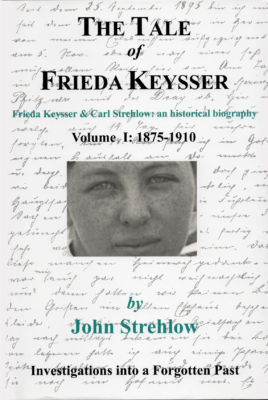
The inspiring story of victory over death and despair by Christian missionaries, who saved from extinction a nomadic people in the Australian desert, considered a “doomed race” without a future by anthropologists steeped in Darwinist race theory.
When Frieda Keysser, aged just 20, set off from northern Bavaria in August 1895 to marry the man of her dreams, she had no idea what lay before her. For Hermannsburg in Central Australia was on the frontier: life was harsh, most Aranda people were still nomadic, and often there was bloodshed. The nearest doctor was a thousand miles away, supplies came up twice a year from Adelaide, and even finding a reliable water supply was a constant struggle.
Passionate and emotional, Frieda was born into an ancient Frankish family which had come down in the world. By age 14 she was orphaned, disinherited and homeless, and at 15 went into service in a clergyman’s family. But then in 1892 she and Carl met – and fell in love. Her romantic, mercurial nature contrasted sharply with Carl’s cool pragmatism and intellectual detachment, but the relationship blossomed into a happy marriage. They had six children, Carl’s language studies and anthropological work attracted international acclaim, while – most importantly – Frieda’s efforts to overcome the problems of infant mortality bore fruit in growing numbers, with Hermannsburg perhaps the only place in Australia where white settlement did not lead to the virtual extinction of the aboriginal population.
Drawing on Carl’s letters and published writings, and based on Frieda’s diaries covering the period, this first volume traces their extraordinary story against the background of growing tension between Germany and England which culminated in World War One, with Carl officially classified as an enemy alien despite Australian citizenship, and rival anthropologist Baldwin Spencer clamouring to turn Hermannsburg into a training institution for half-caste children taken from their families, topics to be covered in the second volume.
Frieda Keysser & Carl Strehlow: an historical biography, 1875 – 1910. Investigations into a Forgotten Past.
ISBN: 978-0-9567 558-0-3
1197 pages; 190 illustrations in B&W, sepia and colour, mostly historic and never published before; 11 maps including 3 fold-out maps; timeline; dramatis personae; 3 appendices and index. Hardback. Wild Cat Press, London 2011.
The inspiring story of victory over death and despair by Christian missionaries, who saved from extinction a nomadic people in the Australian desert, considered a “doomed race” without a future by anthropologists steeped in Darwinist race theory.
Late in the afternoon of 2 July 1894, the Horn Scientific Expedition reached the abandoned mission station of Hermannsburg 80 miles west of Alice Springs, and Oxford-educated Baldwin Spencer, Professor of Biology at Melbourne University, later author and world expert on the Aranda tribe, looked at its collapsing buildings and population ravaged by syphilis, and dismissed the work of the Mission as a mistake. The Aranda would be extinct within 100 years, he predicted. Darwin’s theory made this a foregone conclusion: the Australian Aboriginal was fated to vanish off the face off the earth. Three months later, Carl Strehlow then aged 22, arrived to revitalise Hermannsburg – and proved Spencer wrong.
This is the story of Carl and Frieda’s life together, their dreams, their triumphs, their sorrows and their joys. The tale of a man and a woman who set out to make the impossible come true, and succeeded where others had failed, regenerating this broken community despite the turbulence of the period, while bringing up six healthy children themselves. This is also a tale of strange experience for life was hard and often short and sometimes there was bloodshed.
The frontier age was passing, but the mission station remained cut off from the rest of the world. The railhead at Oodnadatta was two weeks’ buggy ride away and medical help non-existent, so they sent five of their children to Germany for the sake of their education. Although the drift to the telegraph stations, the cattle stations and the railway line had begun, the Aboriginals were still largely nomadic. Blood feud killings were normal, and fights. The ancient tribal ceremonies lived on, and even those who converted had strange visions, receiving hymns from angels, they said, and much else they refused to disclose.
Through it all, Carl was opposed at every turn by Spencer, who did everything in his power to discredit him, being consumed with professional jealousy for Carl’s understanding of the people he worked with. Carl exhaustedly researched every aspect of their lives and, in the process, came up with findings different from Spencer. These were published causing a stir in anthropological circles in London, yet no matter how hard Spencer tried to destroy Carl, he continued from strength to strength. Most annoying of all, the Aboriginal population of the mission was increasing. Spencer’s doomsday thesis was wrong.
Arriving newly married in Central Australia in late 1895, Carl’s wife Frieda found that almost every child born at Hermannsburg died before the age of five. Determined to change this, she set out to discover what was going wrong and how to change it. Based on Frieda’s diaries and Carl’s official letters, the book goes into how she and Carl worked together, so debunking the fashionable ‘doomed race’ theory espoused by Spencer and his co-researcher Francis Gillen.
Carl also researched the two languages spoken on the Mission, Aranda and Loritja, and after German baron Moritz von Leonhardi had contacted him, began writing his magnum opus Die Aranda- und Loritja-Staemme in Zentral-Australien (The Aranda and Loritja Tribes in Central Australia). In it he questioned some conclusions in Spencer and Gillen’s work, starting a vigorous debate in London intellectual circles and earning Spencer’s hostility.
This volume ends with the Strehlows returning to Germany in 1910 with no definite plans to come back to Hermannsburg.
Slide 1
“John Strehlow has contributed monumentally to the historic records of the Northern Territory by accessing the crucially important diaries of his grandmother in Germany . . . We now have first-hand reminiscences of the pioneering days at Hermannsburg through the eyes of a totally Christian woman, a point of view previously unknown. There’s so much in John’s work based on his grandmother’s diaries that will be of benefit to all scholars . . you deserve our congratulations for devoting the majority of your life to this important task.”
Former Administrator of the Northern Territory, Ted Egan AO, launching Volume Two, 1 Dec. 2019.
Slide 2
“But this is far more than the biography of Frieda Strehlow née Keysser, missionary wife in Hermannsburg in Australia from 1895 to 1922, even if she is of course one of the main players. It is also not an historical treatment of the contribution of Carl and Frieda Strehlow to mission work in the Australian Hermannsburg, as the subtitle leads one to assume, although there is much about Carl Strehlow’s mission principles and successes. It is also not a documentation of his ethnological studies, even though ethnological research and Carl Strehlow’s differences with Baldwin Spencer, then the most influential anthropologist in Australia, take up much space. It is all of these things together and still more: an exciting tapestry of family, mission and historical details with illuminating excursions into the cultural anthropology of the era – provocative, enriching, it makes you think. For mission scientists, anthropologists and all for whom Aborigines and the question about the ‘right’ stance towards them is close to the heart, of the greatest interest.”
Dr Hartwig F. Harms, Zeitschrift für Bayerische Kirchengeschichte, 90. Jahrgang 2021.
Slide 3
“Strehlow is very decidedly not an academic. He is a deeply cultured thinker, unslottable, willing to challenge so-called experts on their own ground. He spurns anthropology as an “escapist exercise” and accuses its practitioners of tending to “drown in irrelevant self-importance”. Here and there the shadow of the autodidact comes into play. Self-published and without the blessing of an editor, the book will seem prolix to some and prone to over-long diversions (not to mention typos). But this is part of what makes Strehlow’s writing so clearly his own. Unlike a lot of intellectual non-fiction, it is not an exercise in repeating and re-exemplifying the ideas of les philosophes. Strehlow does not ape his betters, nor, perhaps, believe in them. He writes what he likes. Strehlow is right, those who differ are wrong or confused. Der Wille is steely, like that of his forebears . . . For all its gritty attention to detail, the book has a heroic largeness of spirit, a kind of opulence of space and time and credible personalities, that is so often missing from what is written by scholars of the past and of the bush. It is like the Red Centre itself.”
Prof. Peter Sutton, The Monthly, April 2012.
Slide 4
“Your books are incredible works in the depth and breadth of the topics you cover. It is also so refreshing to see a spirited and articulate defence of the role of religion in improving the lives of indigenous people amongst all people, in this age of moral relativism and “crusading atheism”. It is fascinating to learn more about the early days of European settlement and aboriginal culture and practices, as well as to further appreciate the extreme hardships that well minded pioneer people of the time suffered in living in one of the most isolated places on the planet. Only a hundred years ago! Also I really enjoy the humour in your books, often quite funny.”
Wakinyjan (Catherine) Tabart, Alice Springs, 16 Jan. 2020.
Slide 5
“The passion is in the detail. The proof is in the writing. This immense work took Strehlow twenty-five years to write and gave me eleven months of joy to read at my own pace. Frieda’s Tale takes us through the trials of a young life in nineteenth century Bavaria to hardships of the remote Australian interior in the early twentieth century. A mother and her husband who sacrificed everything dear for a strange people and her faith. It is not for the faint hearted.”
Victoria Swain, Faversham, UK, 2 Dec. 2023.
Slide 6
John Strehlow's book offers us illuminating insights into the beginnings of Aboriginal mission in this country, the often under-rated work of the first Hermannsburg missionaries, the world of Neuendettelsau and its seminary, and the South Australian Lutheran community that supported the Mission. But above all, by highlighting Frieda's perspective and portraying the everyday occurrences of life at Hermannsburg in such depth, The Tale of Frieda Keysser offers a new understanding of the difficulties, tensions and disappointments, but also the patient and painstaking achievements of the men and women on the missions. I cannot imagine a better monument to them.
“Having been an avid reader and student of the history of Australia’s incredible human past, I think your volume is unique in its carefully researched rewriting of the role of Hermannsburg in frontier politics and whitefella understanding of Central Australian indigenous culture . . . you ought to take great pride in having produced a magnificent addition to Australian historical scholarship, and only wish my mother (an avid student of Oz history) had lived long enough to read it. She really missed something.”
Dr Dominic Hyde, Senior Lecturer in Philosophy, University of Queensland, 23 July 2020.
Slide 8
“I applaud John Strehlow for the enormous amount of detailed research which has grown into this work. I hope it corrects some of the misunderstanding and misinformation that has been spread over the years about the relationship between the missionaries and the Arrernte people. I am the product of grandparents who lived with the missionaries, and for that I am thankful. The missionaries left us with our culture, songs and history intact. They gave us the opportunity to understand and learn about the new world with which we had come into contact. The missionaries gave us jobs and assisted us to travel for work, picking fruit, or shearing sheep. They also set up industries like the tannery at Hermannsburg. They gave us hope through faith, and many of us remain strong Lutherans today.
People who have only lived with Aranda for a few years cannot understand the connection between the Aranda and the missionaries. For those of us who grew up with missionary history in Central Australia, there is never a bad word said about the missionaries. We are still grateful for the opportunities they gave us.
This book provides a lesson for anthropologists, past and present. Anthropologists always need to be careful about assumptions they make, especially since there is often no one except their peers to check their work. This book calls into question much that has been written earlier about Hermannsburg. I hope that many Aranda people show up for the launch tomorrow evening and give John Strehlow encouragement. I congratulate Mr Strehlow on the completion of a thorough documentation of a piece of our shared history in Central Australia. I hope and pray that this book helps correct the negative portrayals of the Lutheran missionaries, put forward over the years.”
MLA Alison Anderson, Speech to the House, 30 Nov. 2011.
Slide 9
“This publication, then, is an event. It puts forward for the first time, from Frieda's diaries, a detailed record of day-to-day life at Hermannsburg in the crucial years when the shape of the frontier was being forged, and the survival of the Aranda and Luritja people of the Centre hung in the balance. It explores the Lutheran enterprise and makes plain the constant pressures the missionaries faced: it describes in detail their approach to the collision between western and Aboriginal cultures, and sets that approach against the paradigm advanced by pastoralists and colonial administrators.
Biography. History. Cultural investigation, Strehlow's Tale is all these things, but it would not be truly Strehlovian if it were not, at its heart, a story of displacement, exile and return, an evocation in words of the Inland, its hard, serried paragraphs sheltering abrupt passages of romantic, lyric force . . . Dingoes howl: "that strange, haunting, mournful drawn-out cry which wakes so many sleepers in the wild, penetrating even the deepest dream". This book is a written incarnation of country, the desert in the mind, the same landscape Carl Strehlow found waiting for him, when, barely 20, still fresh from his Franconian seminary training, he was transferred to the centre, to the world of the Aranda. It was the beginning of a love affair, a strange obsession that forms the key theme of this narrative. The Aranda living with him at Hermannsburg became the heart of his life. He mastered their language in its finest details. They were part of him and he would never be fully at ease within his mind again . . .”
Nicolas Rothwell, The Australian, 11 Feb. 2012
Slide 9
I can’t recommend this book too much. Energy leaps off every page (the dramatist again). It is a magnificent, sprawling, disciplined epic but you could dip into any sequence of pages and find things you’d never thought of before. This is a book that will sit on (and help take up) a shelf in my library next to Die Aranda-und-Loritja Stämme (when I buy it), Songs of Central Australia, Aranda Traditions, Journey to Horseshoe Bend, (I might slip in Spencer and Gillen’s Native Tribes of Central Australia as loyal opposition) and Barry Hill’s Broken Song as visual tribute to a great Australian family of writers.
Gordon Williams, librettist of the cantata Journey to Horseshoe Bend, 2012.
Slide 10
“JS vents much scorn throughout the book on the ‘self-appointed experts’ like Francis Gillen and on the whole profession of anthropology that gorged itself on information supplied by missionaries, all the while criticising them, with its career professionals too busy to spend time with indigenous people. They ignored conflict like inter-tribal conflict, payback violence, and infanticide, so that anthropology was bankrupt before it ever opened for business, JS writes. The book seeks to rectify every mistake that has ever been made in judging Carl Strehlow and Hermannsburg: nobody was forced to enter the mission, and indigenous people were not stripped of their culture by the mission. Only about a quarter of the mission residents were Christians, and only Christians were barred from corroborrees, simply because Lutherans did not dance.
While the argument might be predictable from someone whose family has been so picked over by critics, this is original scholarship with original insights, ideas and reflections, not gleaned from well-ploughed publications. JS is scornful of the errors of the published work on Hermannsburg, and only a few have slipped in here – confusing Bloomfield with Cape Bedford on p.262, overlooking that Easter egg painting is alive and well throughout (Catholic) Germany, referring to Kalbensteinberg as Kalbensteinbach, and in some instances one can either believe it or not, because the sources are sparsely annotated. The doctrinal sectarianism of the South Australian Lutherans who supported the mission, too, gets short shrift: it was the ‘Lutheran theocracy of the country’, ‘indulging in their favourite pastime, religious schisms based on irrelevant doctrinal disputes’ (p.300). The book is a vindication of the Strehlows, but it is eminently readable and interesting, and the language is often deft, the work and its conclusions entirely original.”
Prof. Regina Ganter, Aboriginal History, 2015.
Slide 11
“What I find most fascinating about The Tale of Frieda Keysser are the little vignettes of frontier life. When the social history of central Australia is written, this book will provide an invaluable guide, overflowing as it is with letters and unduly neglected journals, articles and books. We hear of the sexual relationships between white men and black women, where the white settler would be incorporated into the Aboriginal kinship system. Consequently, having given the man a wife, her kin would settle near his station, receiving in exchange meat, flour and tea. This was the rationale underlying the notion of traditional promised marriage. . . The Tale of Frieda Keysser is unique in its excavation of a huge number of ignored and forgotten primary sources, bringing to light unknown historical terrain as vast as the central deserts themselves. This is a good thing, as a great deal of our past is itself a terra incognita, unknown and unexplored. Much of what is written about the history and the present state of the centre seems more like mirages created by the human mind, not the things themselves. This book is a seminal contribution to the difficult task of dispelling such mirages.”
Garry Clark, Quadrant, April 2014.
Slide 12
“The Tale of Frieda Keysser is a superb achievement, and an important cultural event. It may well promote respect on several fronts. It comes as an antidote to much popular as well as academic derogatory parlance on missions and the mark they've left.
At the same time it offers balm for the still hurting and abused image of Australia's Aboriginal people- and it does them honour. It also honours ordinary faithful people of the time: this handful of Lutheran families', who undertook 'what the State of South Australia could or would not [undertake], the care and nurture of those tribes broken by the advent of white settlement' ”
Maurice E. Schild, Lutheran Theological Journal, August 2012
Slide 13
The book includes many illustrations, which bring the story to life, and maps, which assist the reader in precisely locating the events described. This is truly a work of love for a family, for history, for the church, and for the mission of God.
Prof. Craig L. Nessan, Wartburg Theological Seminary (USA), Currents in Theology and Mission, 2015.